

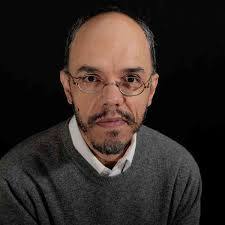
Here we reproduce part of the interview conducted by Milena Buarque with Caetano W. Galindo, a professor, writer, and literary translator, which was published in ItaúCultura. In it, he shares lessons learned from his translations and offers insights into the Brazilian literary translation market.
Sixty-two articles appear in the“Translated Books”section of the website dedicated to the professional work of Caetano W. Galindo. A professor in the Department of Linguistics, Classical and Vernacular Literature at the Federal University of Paraná (UFPR), as well as a researcher, writer, and translator, Caetano is currently one of the leading figures in Brazilian literary translation. His Portuguese translation of *Ulysses* by Irish writer James Joyce has received the country’s most prestigious literary awards, including the 2013 Literary Prize, awarded by the Brazilian Academy of Letters (ABL).
“The translation of *Ulysses* means everything to me. It gave me my career as a translator, my career as a researcher in academia, the position I hold in the academic system here at the Federal University of Paraná—and, eventually, beyond it—and it helped me grow tremendously as a reader, as a translator, and as a person. It gave me everything,” he says, recalling the work he began during his Ph.D. in linguistics more than a decade ago.
“Everything we read changes us to some extent, in one way or another, and ultimately shapes us as readers—both what is literary and what is not.”
In an interview on the Itaú Cultural (IC) website, Caetano shared some of his experiences in literary translation to date and offered an optimistic assessment of what he calls the “maturation” of the country’s current translation market. He also cited artificial intelligence as a turning point.
How did you start your career as a translator?
Caetano says there were many beginnings. Today, looking back, he sees that, in various situations, he became interested in and involved with several translation projects without even intending to. He has a bachelor’s degree in French from the Federal University of Paraná. He recalls that, on one occasion, a teacher challenged her students to translate a sonnet by the poet Arthur Rimbaud, so he sat down at home and immediately realized how much fun it was not only to translate languages but also to find the rhymes. It felt like solving a puzzle. He felt very happy when he came up with a translation. In college, he had a friend who was very fond of the Theater of the Absurd but didn’t know English. She had read a play by Tom Stoppard and thought her friend would enjoy reading it, so she made up an excuse that she wanted to give it to her as a birthday present. Interestingly, this text ended up being republished later in the volume *Rock ‘n’ Roll and Other Plays*, published by Companhia das Letras in a completely different version—mainly because Stoppard himself had already revised the text by that time.
So there were several occasions when he was involved in translation, but this only became clear to him after a colleague, Mauricio Mendonça Cardozo—who had trained in translation and earned a Ph.D. in translation theory (at a time when that wasn’t very common)—had the idea of creating a translation studies program at UFPR. He graduated alongside Mauricio, and they later worked together at the university as professors. They had already been discussing the topic, and he thought it would be interesting to bring this idea of creating a translation program to life. It was from this academic perspective—starting with his translation of *Ulysses*—that some publishers began to take notice of his work and invite him to take on various projects. In 2003, he began working as a translator and never stopped. That’s how things came together—based on this academic impetus, so to speak.
Caetano W. Galindo’s translation of James Joyce’s famous *Ulysses*, published in 2012 by Companhia das Letras, earned him three major awards: the Brazilian Academy of Letters, the São Paulo Association of Art Critics (APCA), and the Jabuti Prize. What were the greatest joys and challenges of this translation?
Translating *Ulysses* meant a great deal to him. Translating *Ulysses* is very difficult, although he always says it was much easier for him than it was for translators of the past. Over the years, more reviews became available, as well as online platforms to help him clarify his doubts. He completed the work in ten years, and the development of this review of *Ulysses* was exponential. Today, it’s much easier to access the book, thanks in part to the work of translators, Caetano asserts.
There were further complications and a great deal of suffering, but he says he would never describe the process that way. According to the translator, the process of translation—followed by editing, publication, and the book’s reception—is a story of great satisfaction and pleasure. He feels enthusiastic about the idea of overcoming a challenge. This is what made him realize just how much he was meant to stay in literary translation.
Milena Buarque asked him if he read the text before translating it, since, according to her, there are translators with different approaches: some used to read, but began translating as they read, discovering the book as they went along—often due to deadlines or surprises in the narrative—while others skim through the text before translating.
Caetano said that, in some cases, he ended up translating books he had already read, reread, and reflected on, which for him is actually one of the reasons why he sometimes feels dissatisfied with the result of the translation, since he personally prefers to sit down to the first page with a sense of complete unfamiliarity.
He likes to sit on the edge of his seat and translate intently, engrossed in the book, the reading, and where the story is headed. He likes the anticipation of translating while immersed in the rhythm of the book itself. He likes that feeling of translating as he reads, because it makes him more attentive, more perceptive, more alert, and leads to a more interesting result. He says that, when revising a translation, he rearranges the first few pages. But it’s also true that, with a little experience as a reader and a little experience as a translator, you can quickly recalibrate most books. So it’s not really a major problem for him either.
What did your translations teach you?
Translating taught him a great deal as a person, a reader, and a translator. He learned to translate high-quality literature that should stand on par with the great authors. Literary translation is an activity that should be done in “spare time” by people who have other jobs that allow them to pay the bills. However, this isn’t a problem, since he is a college professor and has a stable job that allows him some flexibility in his schedule.
“The literary translator is a co-author; he is the author of the text’s ‘skin’ that you are about to receive.”
He also mentioned that a literary translator is a kind of co-author, because they write the words that the reader will read. Therefore, whenever a reader praises an author’s style while reading a translation, that style has been filtered through another person. On the other hand, he points out that groups of translators have recently formed to discuss aspects of the profession, and he considers this a positive development, especially in relation to the Brazilian publishing market. For Caetano, there have been many positive changes, as there is a growing trend toward giving credit to and highlighting the name of the person who did the translation. There has also been progress regarding the field of literary translation itself in Brazil, which has become more professional in a different way. Today, there are many skilled individuals with a solid background in literary translation—people who have grown up in a world where literary bilingualism is much more common, frequent, and deeply ingrained.
According to the Brazilian translator, there is a vast community of people who also write and translate—creators who translate and translators who create. “This gave rise to—and I believe this is the generation immediately following mine—a sort of ‘golden age’ of translation in Brazil,” he says. Subtitle translation is at a very high level today. He also believes that even social media plays a decisive role because it allows these professionals to show who they are and make themselves known, fostering a kind of loyalty—after all, if you follow a translator on Instagram, you know what she posts, and you “look for that person’s brand, so to speak.”
To what extent does your work as a translator end up influencing your literary writing?
For the Brazilian, the influence is total, since it’s as if you spent ten years as a mechanic—taking engines apart, repairing engines, putting engines back together—and then suddenly decided to design an engine, build an engine, build a car, and design a car. You trained, you learned—and in his case, he says he learned—from the best. He translated a great deal of excellent literature. And translating literature means understanding the mechanisms, digging under the hood, dealing with the parts, having to reproduce very delicate elements, and making sure they still work in Portuguese.
How can literary translation reflect a country's cultural identity? Can translation play an important role in promoting cultural diversity?
In the words of Caetano Galindo, literary translation is also a product of a country’s cultural identity. Central and peripheral cultures—both terms used in quotation marks—approach this in different ways: they translate more, they translate less, they translate from one perspective or another. This ultimately affects how the literary translation system functions. And translation is perhaps the most powerful mechanism we have in literature and the verbal arts, as it fosters an appreciation of cultural diversity and an understanding of the cultural diversity within a given system. A system that, according to the Brazilian translator, might be isolated, producing for itself, closed off within itself—and suddenly finds itself exposed to other ways of thinking, other ways of speaking, other genres, other styles… The more translations—that is, the more versions of the same translated work—the more diverse the perspectives will be, expanding ever further, he points out.
What advice would Brazilian translator Caetano Galindo give to novice translators or those looking to break into the profession?
For him, the first step is to study Brazilian Portuguese—not in an academic sense, but through total immersion. Read a lot; read widely and variedly; read good and bad literature, literature and non-literature, pulp fiction and highbrow literature. Fiction, nonfiction—all kinds of texts, from every era and genre. Read old texts, new texts, texts published in books, and texts on the internet. You must cast aside each and every notion of superiority and inferiority, of adequacy and inadequacy—this is possible, this is not possible, this is required, this is not required. Language is what it is, he asserts. And then he continues: “This universe is vast, wonderful, and almost inconceivable in its variety of divergent and contrasting forms of expression, and you must love it, you must enjoy it. You must enjoy writing poorly, you must enjoy writing well, you must enjoy writing in a crude, ridiculous, elevated, lyrical, motivational, and repulsive manner.” According to Caetano, all these things should be part of your repertoire, in addition to studying with people in the field, since that is very valuable: the idea of a professional community, of working with someone who’s already in the field, asking for guidance, and showing your work. But, on the other hand, his advice is: Don’t do that! Because he believes this isn’t a good time to break into the literary translation profession. Literary translation, with a few exceptions, has never been a career. It’s an activity that, in his view, can generate some income and offer some kind of personal growth; however, while it can turn you into a writer, help you prepare manuscripts, or even land a job at a publishing house, it’s very difficult to think of literary translation as a career, since it doesn’t provide enough money to pay the bills. Furthermore, he asserts that it is a slow, costly, painful, and physically demanding activity.
“These days, everyone works as a service provider, so there are no vacations, no year-end bonus—nothing,” he says. Another drawback he mentions is that we may currently be at a very difficult turning point in the history of these careers, with the somewhat ominous shadow cast by the emergence of translation models that use artificial intelligence. He concludes the interview with this message: “Think about it—keep your Plan Bs, Cs, and Ds up to date. If you’ve caught the literary translation bug, get your degree, work, and keep moving forward, but it’s probably not the best idea to think of it as a career that will guide you, shape your life, and pay the bills from now on.”
Photo Courtesy of [Source]


